This guide explains how to evaluate Valter offerings with a practical, evidence-focused approach to pricing and supplier selection. “Valter” is often used as a product or brand identifier across different categories, so objective screening matters. The article outlines criteria, documentation checks, and purchasing conditions to reduce risk and improve fit for your needs.
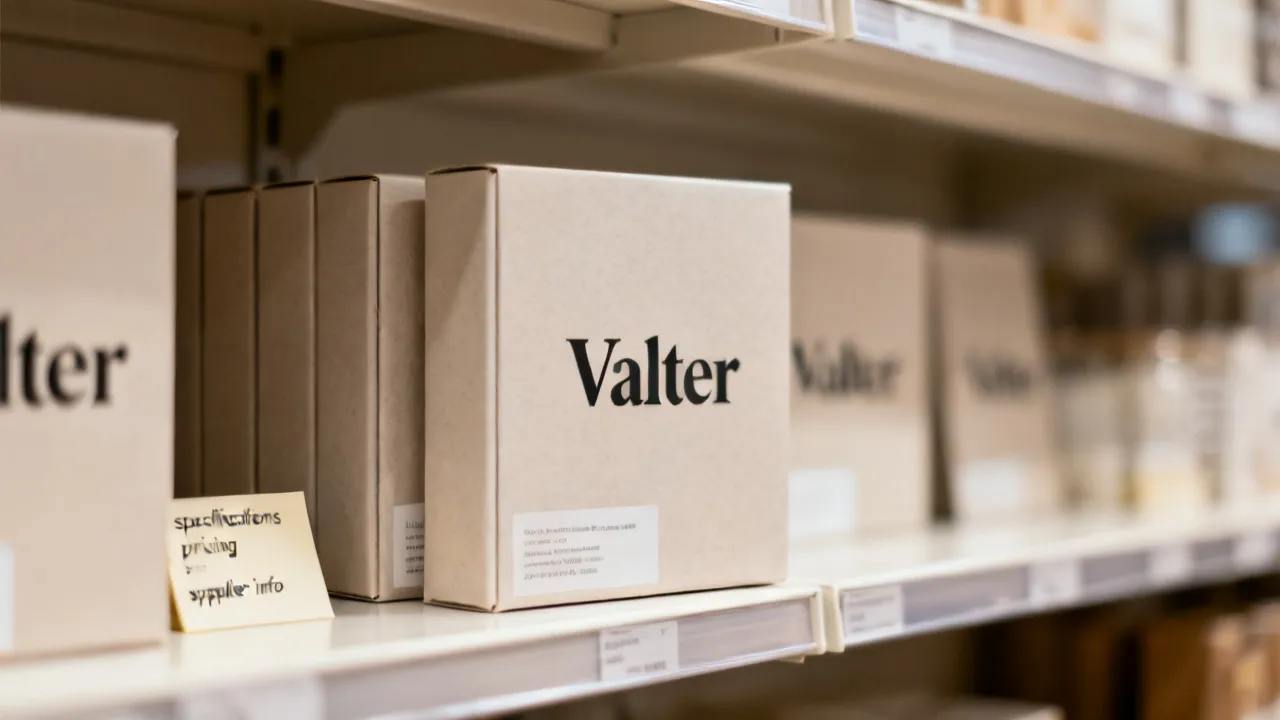
When you encounter “Valter” in a shopping or sourcing context, the smart first step is to treat pricing and supplier identity as tightly linked variables: the same “Valter” label can represent different product configurations, compliance tiers, distribution channels, service packages, or even slightly different manufacturing batches. That means the same-looking price tag can conceal meaningful differences in what you will actually receive, what documentation you’ll get, how long you’ll wait, and who will be responsible if something goes wrong.
This guide focuses on how to evaluate Valter offerings using consistent decision criteria—so you can compare price more meaningfully, verify supplier capability, and choose the option that best matches your operational requirements. The goal is not just “getting the lowest number,” but getting the lowest risk-adjusted cost, where risk includes downtime, rework, warranty disputes, missing spares, installation constraints, and documentation gaps that can block acceptance in regulated environments.
To keep the process objective, you should anchor your comparisons on verifiable details such as documentation, warranty terms, lead-time transparency, packing and traceability evidence, and the supplier’s ability to support installation, maintenance, training, or integration (as applicable). If you only compare numbers, you risk paying less upfront while losing value through mismatched specs, unclear responsibility for failure modes, incomplete after-sales support, or an inability to produce compliance records when someone asks later.
Key takeaway: For any Valter purchase, compare “price + proof.” Proof includes product documentation, traceability information, and clear contractual terms that define exactly what you are buying and who does what.
“Valter” is commonly used as a brand, product line name, model identifier, or shorthand label in procurement conversations. Sometimes it is a formal brand; other times it is a reseller’s naming convention, a project code, or an umbrella term for multiple variants. Because the same term can appear across categories (and sometimes across regions or resellers), the buyer’s first responsibility is to confirm what exactly “Valter” refers to in the specific listing you are considering.
In practice, buyers should validate the following before doing any real comparison:
From an industry perspective, label-based confusion is a recurring procurement risk. Teams sometimes assume that if the product name says “Valter,” then the product is effectively the same everywhere. But in real supply chains, a label can cover:
Therefore, a rigorous approach is essential. If you treat “Valter” as a single, fixed thing, you will inevitably face mismatches later. If you instead treat “Valter” as a label that must be tied to a verified SKU and configuration, your comparisons become far more defensible.
Pricing comparisons for Valter should be structured around total cost of ownership (TCO) rather than the displayed unit price. A lower unit price can be perfectly valid—or it can be a sign that you are receiving fewer inclusions, less documentation, a narrower warranty, or limited responsibility for installation and commissioning issues.
Industry professionals often break down TCO into practical purchasing elements:
Because your prompt did not provide specific numeric price data or a named supplier, this article deliberately avoids unverified claims about “typical” pricing levels. Instead, it gives you a reliable comparison methodology that works regardless of the exact amounts.
Professional note: If a “Valter” offer is dramatically cheaper than comparable channels, it may reflect differences in specification level, warranty coverage, documentation completeness, or supplier responsibility boundaries. That is not automatically negative. But it is a reason to require written clarification before purchase.
To avoid value loss, you should also compare the “cost of certainty.” A slightly higher offer might include better documentation, faster lead times, and clearer warranty terms, reducing your internal administrative cost and protecting your schedule. In many procurement environments, that certainty has real financial impact, even if it isn’t visible in the invoice.
Supplier choice matters as much as the product name. A great Valter deal from an unreliable supplier can become expensive once you need warranty support, spares, or replacement logistics. For Valter purchases, a high-quality supplier typically demonstrates:
Even when you find a supplier that appears competent, it’s still wise to request evidence tailored to your exact configuration. Procurement teams often standardize a “supplier proof pack” to reduce negotiation friction and improve consistency. Such a proof pack can include:
This prevents a common failure mode where the supplier “explains later” after the order is placed, making disputes more expensive and timelines more fragile.
In many procurement environments, the decisive factor is not whether a supplier can sell a “Valter” product, but whether they can meet the operational conditions that make the purchase successful. Depending on the product category, common requirements include:
These conditions are especially important for “Valter” when the term could appear across multiple configurations. Your contract and purchase order should remove ambiguity. Practically, that means you should avoid wording like “Valter unit as listed” or “Valter equivalent.” Instead, you should specify the exact SKU, revision, and configuration, and require the supplier to confirm in writing.
Additionally, if your purchase will be integrated into a system (electrical, mechanical, software, industrial processes), you should clarify whether “Valter” is supplied as a standalone item or as part of a broader system configuration. Integration requirements can drastically affect commissioning costs and project timelines.
| Evaluation Area | What to Ask for (Valter) | Why It Matters | Buyer-Friendly Outcome |
|---|---|---|---|
| Product Identity | Exact model/version, SKU, and configuration details | Avoids mismatched specs under the same “Valter” label | Written confirmation of the exact item quoted |
| Pricing Basis | Unit price plus line-item inclusions (shipping, accessories, service) | Ensures fair comparison of “like for like” | Transparent quotation breakdown |
| Warranty and Returns | Coverage duration, scope, exclusions, and return procedure | Reduces post-purchase cost surprises | Clear terms that match your risk tolerance |
| Supplier Traceability | Batch/serial information and quality documentation (where applicable) | Supports audits and maintenance reliability | Documented traceability in your package |
| Lead Time and Availability | Stock status, estimated dispatch dates, and contingency plan | Protects project schedules and reduces downtime | Realistic dates and a defined escalation path |
| Service and Spares | Service model, spare parts availability, and response timelines | Improves uptime and good value | Documented support plan |
Use this workflow to evaluate Valter offers methodically—especially when comparing different suppliers or distributors. This approach is designed to reduce common procurement errors: buying the wrong variant, accepting unclear inclusions, or discovering after delivery that warranty and documentation requirements do not match your acceptance criteria.
From a procurement and supply-chain standpoint, the most common failure mode in “Valter” sourcing is not outright fraud—it is ambiguity and mismatched assumptions. In industries where specifications matter, a term like Valter may be used as a convenient shorthand, but the decisive question is always what is actually being supplied.
Industry professionals typically protect their organizations using structured evaluation habits:
In short, a well-run procurement process turns a label like “Valter” into a verified item with measurable support and contractual clarity. The difference between a “good deal” and a “bad deal” is often not the price itself but whether the buyer can prove what was purchased and enforce responsibilities afterward.
Even in routine purchases, buyers should pay close attention to conditions that can change outcomes after the order is placed. While the exact conditions depend on the specific Valter category, these are common themes. When these terms are unclear, the buyer assumes hidden risks—especially if the supplier’s warranty or returns process is weak or difficult.
When you see a quotation that is attractive but vague on these points, it may be a sign that the supplier is not aligned with the level of operational clarity buyers need. In many cases, you can resolve ambiguity by asking for specific documentation and requesting a written statement that maps the quotation to the final shipped item.
Because this article avoids unverified pricing claims, it emphasizes widely accepted purchasing controls. For background principles on procurement risk management and quality systems, professionals often reference standards and guidance such as:
These references are not substitutes for your specific contractual needs, but they provide objective structure for decision-making in purchasing environments. If you share your sector (industrial goods, electronics, textiles, software licensing, construction materials, medical-adjacent equipment, and so on), you can tailor the compliance and documentation checklist accordingly. Different sectors require different evidence: for some it is certificates of conformity; for others it is cybersecurity documentation; for others it is test results and traceability records.
In practical terms, evidence-based procurement means you build a requirement list that is easy to audit. Instead of asking “Can you provide quality?” you ask “Can you provide a quality certificate, test report, and serial traceability matching the shipped unit?” This shifts the conversation from promises to deliverables.
Beyond the core steps, you may want an expanded checklist you can reuse for every “Valter” request for quotation (RFQ). This is especially useful when multiple procurement team members or departments handle purchasing across time, regions, or suppliers.
A) Define the “exactness level” you need
Many procurement failures happen because “equivalent” is treated as a casual term. For technical products, “equivalent” must be defined with boundaries and documented evidence.
B) Normalize quotation structure across suppliers
This prevents apples-to-oranges comparisons where one supplier quotes only the hardware and another quotes an end-to-end ready-to-operate package.
C) Validate warranty and returns in operational terms
Make warranty evaluation practical. A warranty that looks good on paper can be weak if replacement logistics or response timelines shift costs onto you.
D) Demand traceability and documentation alignment
Traceability is not a “nice-to-have.” It is often required for audits, maintenance scheduling, and warranty adjudication.
E) Check lead time assumptions and what happens if schedules slip
If “Valter” is time-sensitive for your project, you should treat lead time as a deliverable with a change-control mechanism. Vague lead-time language creates schedule fragility.
F) Assess integration and responsibility boundaries
Responsibility boundaries become critical when outcomes depend on system-level integration rather than standalone performance.
One of the biggest buyer risks when evaluating “Valter” offers is accidentally comparing different variants. This can happen due to:
To prevent like-for-like errors, adopt a “spec lock + inclusion lock” method.
Spec lock: Ask each supplier to confirm the exact SKU, revision, and technical parameters. Request a “confirmation of quote match” statement. Ideally, include a clause in your purchase order that the supplier must deliver the exact quoted SKU.
Inclusion lock: Ask each supplier to list everything included in the price. If one supplier includes installation support and another does not, you can adjust TCO, but you must not assume equivalence. The difference between “hardware price” and “ready-to-operate package price” is often substantial.
In practice, you can also use a comparison template that highlights the “must-match” items. Examples of must-match fields include:
If the supplier cannot provide that mapping, treat the offer as incomplete until clarified.
Supplier fit is often misunderstood as a “does the supplier respond quickly?” question. Response speed matters, but the deeper issue is whether the supplier can support the product throughout its lifecycle. A supplier might be good at quoting and selling but weak at handling warranty claims, providing spares, or resolving installation issues.
When evaluating supplier fit for Valter, ask operational questions that reveal capability. Examples include:
These questions force suppliers to disclose how they operate, not just what they sell. The answers should be specific and aligned with real-world logistics.
Another angle is to examine whether the supplier’s responsibilities match your internal capacity. If you do not have installation teams, you must ensure that the supplier offers commissioning support or works with certified installers. If you do have internal teams, you might still need the supplier to provide precise technical documentation and configuration guidance.
Supplier fit also includes governance: your ability to escalate disputes. A good supplier has a clear escalation path for lead-time delays, warranty disagreements, and nonconformance.
Once you understand what “Valter” means and how to compare offers, you can negotiate more effectively. Negotiation is not only about price reduction; it’s often about converting uncertainty into documented commitments.
A) Ask for quote line-item rework
If a supplier gives a single total number with minimal breakdown, request a line-item quotation. You want separate lines for hardware, freight, packaging/handling, documentation processing, and service coverage. Line items reduce disputes and allow you to challenge differences logically.
B) Convert “best effort” promises into specific commitments
C) Use evidence requests as negotiation leverage
If a supplier can deliver high-quality documentation and traceability, they can usually provide it before shipping or even before contracting. If they refuse to provide proof up front, they may be offering limited reliability. You can ask them to produce a “proof pack” and make that pack part of acceptance criteria.
D) Clarify remedies
Negotiation should include remedies: if the unit is wrong, damaged, late, or incomplete, what happens? Remedies might include replacement at no extra cost, refund, extended warranty, or freight coverage. Without remedies, the buyer absorbs operational costs.
To choose wisely, it helps to map realistic risk scenarios and verify controls. Below are common risk patterns that can occur with “Valter” label purchases, along with the buyer controls that typically prevent them.
Scenario 1: Wrong variant delivered
Scenario 2: Documentation mismatch
Scenario 3: Warranty starts too early
Scenario 4: Lead time slips with no remedies
Scenario 5: Warranty service cost shifts to buyer
Scenario 6: Incomplete integration support
By anticipating these scenarios, you can structure your RFQ questions and acceptance criteria to prevent them before they occur.
Even after you do everything right during procurement, the receiving process remains a critical control. Your acceptance process should verify that what arrived matches what was quoted and what was contractually promised.
A) Verify shipping documents
B) Verify physical and packaging integrity
C) Verify documentation alignment
D) Perform acceptance testing aligned to your requirements
E) Close the procurement loop
This acceptance process reduces disputes later and supports maintenance and warranty claims with real evidence.
Buyer psychology often drives a risky conclusion: “Lower price must be better” or “Higher price must mean better.” Neither is reliable. The responsible approach is to interpret price differences as signals that require verification.
When you see a lower price, possible reasons include:
When you see a higher price, possible reasons include:
In either direction, your goal is to clarify which differences are real and which are superficial. The “best” choice is the one that meets your operational requirements and risk tolerance, not simply the one with the lowest invoice value.
“Valter” typically functions as a brand name, model identifier, product-line label, or shorthand used by a seller. However, the exact meaning depends on the listing. You should confirm the exact SKU, version, and configuration details to ensure you are comparing the same item across suppliers.
Compare “like for like” by requesting a quotation breakdown: unit price, shipping/handling, included accessories, service terms, warranty scope, and any documentation included. Normalize the structure of the quotes, and consider total cost of ownership (including downtime and warranty logistics), not only the unit price.
Request documentation and operational clarity, such as warranty terms, lead-time estimates, return policy conditions, and traceability details (batch/serial information where applicable). If installation or commissioning is relevant to your category, ask about support availability and responsibilities, and request integration instructions or documentation lists.
Yes. Ambiguity can lead to receiving an item with different technical specifications, compatibility constraints, or warranty coverage. Industry top practice is to tie the purchase order to the exact SKU and require written confirmation before dispatch, and then verify the shipped unit identifiers against the documentation at receipt.
Focus on specification confirmation, delivery/dispatch dates, warranty start date and coverage boundaries, return/replacement procedure, damage-in-transit claims handling, and how discrepancies will be resolved. Include responsibility boundaries for installation/commissioning if relevant.
Check the packing list, serial/batch details, and documentation against the confirmed SKU and quotation. If the supplier provides manuals or certificates, ensure those documents align with the item identification on the shipment.
Not automatically. A lower price can be legitimate, but you should investigate why it is lower. Validate inclusions, warranty coverage, documentation completeness, and supplier responsibility. If differences are not clearly documented, treat the deal as a risk until the supplier provides written clarification and evidence.
Do not proceed as if everything is resolved. Immediately notify the supplier using the contract’s nonconformance/discrepancy process. Provide evidence (photos, packing list details, serial/batch IDs, and the document gaps). Require the supplier to supply corrected documentation that matches the delivered unit identifiers.
Reduce disputes by requiring clear warranty terms in writing, capturing acceptance test evidence, and keeping documentation aligned with serial/batch IDs. Also confirm warranty start conditions and service process details before purchase so you understand who pays freight and how RMA requests are handled.
It matters if your ability to install/commission affects product performance, safety, or acceptance testing. If installation impacts warranty validity or causes integration failures, you need written clarification on whether the supplier provides required installation instructions, commissioning support, and troubleshooting boundaries.
Yes—many reputable suppliers can provide example documentation bundles or describe their traceability process. For specific serial/batch numbers, exact traceability may be possible only at dispatch. However, the supplier should be able to confirm that traceability will be included and show what documentation will accompany the shipment.
Only accept “equivalent” substitutions if the supplier provides a formal equivalency statement with specific spec deltas (not vague claims). Your procurement team should decide whether substitutions are permissible and under what conditions. Ideally, define non-substitution rules for critical parameters.
Ask for a dispatch timeline with update cadence, a contingency plan, and escalation contacts. If delivery timing is mission-critical, include contractual remedies for late delivery or define acceptable substitution criteria.
No. Keep the invoice plus packing list, documentation bundle, warranty terms, and any serial/batch traceability records. These documents support audits, future maintenance, and warranty adjudication.
Buying under the Valter label becomes straightforward when you treat pricing, supplier capability, and documentation as inseparable evaluation criteria. Rather than relying on the brand name alone, confirm the exact SKU, normalize comparisons across offers, and require contractual clarity on warranty, returns, lead time, and responsibilities.
This evidence-focused approach supports better decision quality and protects the value of your purchase. When you can prove what you bought—what configuration, what warranty terms, what documentation, and what traceability—you reduce operational risk and prevent expensive surprises after delivery.




This guide explains how to evaluate Lino pimentel-related purchasing decisions, focusing on supplier credibility, pricing structure, and practical requirements. Lino Pimentel is a person-name often appearing in procurement or local business contexts; “Lino pimentel” may also function as a reference for brands, resellers, or contact points. The article outlines an objective framework for sourcing quality and managing cost.

This guide explains how to evaluate Ru.auero for reliable component supply decisions. Objectively, the name “Ru.auero” is treated as a sourcing reference within the broader electronics supply ecosystem, where quality, traceability, and documentation often matter as much as availability. You’ll find expert criteria, practical checks, and requirements to compare suppliers.
This guide explains how to think critically about adult content (Porno) online, focusing on safety, privacy, and responsible consumption. Background context covers what “Porno” commonly refers to, why platform moderation and age verification matter, and how to evaluate risk. The article then provides a structured comparison of filtering options, practical requirements, and FAQs grounded in responsible digital practices.

This guide explains how to evaluate Jaqueline options with a practical, expert approach to selection, sourcing, and fit. Background context covers what “Jaqueline” commonly refers to in retail and service contexts, why suppliers matter, and how to assess quality without relying on marketing claims—helping you make consistent decisions based on verifiable requirements.

Jaqueline-related offerings can be assessed more clearly with a buyer-focused checklist that explains what matters, how suppliers typically structure options, and how to compare services objectively. Background context is provided on the meaning of the term “Jaqueline,” common purchase considerations, and why transparent requirements improve outcomes across categories.

This guide explains how to evaluate Jaqueline-related offerings with an evidence-based approach to supplier selection, pricing structure, and quality checks. “Jaqueline” is commonly used as a personal name and brand-like identifier in catalogs, invoices, and service descriptions. Background context discusses why supplier transparency, documentation, and service conditions matter when comparing options.